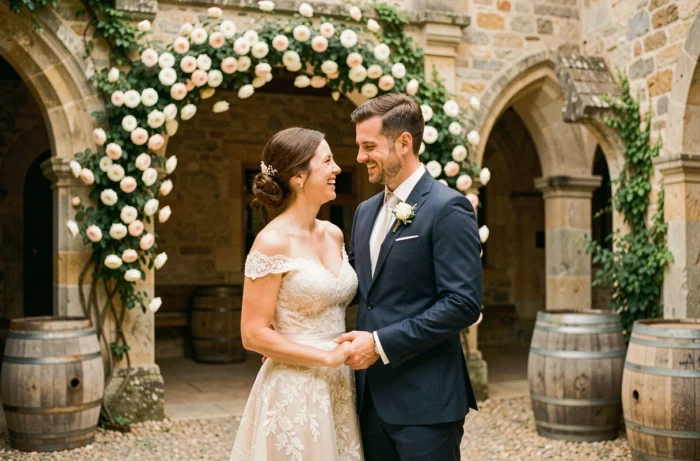
A personalized wedding is not just about choosing a color palette and a caterer. Couples who achieve a cohesive result make decisions in advance on points rarely covered by traditional guides: regulatory constraints from the town hall, management of guests’ personal data, format over one or two days. Here, we detail the concrete levers that make the difference between a wedding that feels imposed and one that is well-managed.
Regulatory constraints of the civil ceremony at the town hall
The civil ceremony is not just a simple administrative formality. Each town hall applies its own internal regulations regarding music, speeches, audio equipment, the number of participants allowed in the room, and accessibility requirements. Ignoring these parameters can lead to last-minute refusals.
We recommend contacting the civil registry service at least four months before the chosen date. Ask specific questions: maximum duration of the ceremony, possibility of playing personal music through your own speaker, permission for relatives to read texts. Some town halls impose a fixed slot of twenty minutes, while others allow more flexibility.
The accessibility of the venue must be verified in person, not just by phone. Steps, door widths, reserved seating: these details affect the comfort of your guests with reduced mobility. Couples who prepare a complete file in advance, including the planned equipment and desired schedule, find it easier to obtain accommodations.
The providers listed on e-mariage.fr often offer support with these administrative procedures, ensuring nothing is overlooked during the preparation phase.
Protection of guests’ data during organization
Digital tools are multiplying in wedding planning: response management apps, shared photo galleries, address collection forms for invitations. Each tool collects personal data that falls under GDPR, even in a private context as soon as a third-party provider processes this information.
Before subscribing to a wedding app, check three points:
- Data hosting: servers in the European Union or outside the EU, retention period after the event, possibility of complete account and data deletion.
- Sharing with third parties: some platforms sell email addresses or phone numbers to commercial partners. Read the terms and conditions, not just the homepage.
- The shared photo gallery: who can download the images, who holds the usage rights, and can guests request the removal of a photo in which they appear.
A simple encrypted spreadsheet hosted on a personal cloud remains the safest solution for managing the guest list and RSVPs, without entrusting this information to an intermediary.
Two-day wedding: balancing budget and experience
The two-day format is no longer reserved for large budgets. It meets a concrete logistical need: welcoming guests from afar, spreading out key moments to avoid a marathon day, and reducing food waste by reusing some resources from the first day for the brunch the next day.
The Vows & Venues study reported by the Journal des Femmes confirms this trend towards an extended format. The following day’s brunch is no longer seen as a secondary activity. It constitutes a real reception time, often more relaxed than the evening, where exchanges between families happen naturally.
Budget items to redistribute
Extending the wedding over two days does not mean doubling the budget. We observe that couples who choose this format often reduce other items:
- Simplified decoration on the first evening, reused as is for the brunch, which divides the floral cost.
- Single caterer negotiated for both meals with a decreasing rate, rather than two separate providers.
- Group accommodation at the reception venue, eliminating transportation costs and risks related to drinking and driving.
- Brunch entertainment provided by relatives (quizzes, speeches, projections) rather than by an external provider.
The actual additional cost focuses on the venue rental for an extra night and breakfast. For a venue already booked for Saturday night, extending until Sunday noon often represents a reasonable addition compared to the overall budget.

Wedding personalization: what really matters
Personalization does not come from the accumulation of decorative details. A personalized wedding relies on the coherence between the venue, the day’s rhythm, and the culinary choices. Three aligned elements are enough to create a strong identity. Ten disparate details produce the opposite effect.
The choice of venue conditions everything else. A vineyard calls for a menu centered on food-wine pairings and a sober scenography. An urban garden leans towards a cocktail dinner format and a more relaxed atmosphere. We recommend starting from the venue to build the rest, not the other way around.
Secular ceremony: technical framing
The secular ceremony remains the moment where personalization has the most emotional impact. Its effectiveness relies on strict framing: duration limited to between twenty and thirty-five minutes, three to four speakers maximum, and a narrative prepared in advance with an experienced officiant.
Ceremonies that exceed forty minutes systematically lose the attention of guests. It is better to select two strong texts than to pile up six out of politeness towards relatives. The officiant should receive the texts at least three weeks in advance to adjust the overall rhythm and avoid redundancies.
The most memorable wedding is one where each element serves the same purpose. Focusing energy on three structuring decisions (venue, format, ceremony) rather than on fifty micro-decorative choices remains the most reliable method to achieve a result that is both personal and well-managed.