
You order a size L top from a French site, and it fits you perfectly. The following week, a size L purchased from a German store is loose at the shoulders. Size L in clothing does not refer to a single measurement: it varies by brand, country, and even type of item. Understanding what this letter represents is primarily about knowing how to read the right measurements in the right place.
Why size L changes from brand to brand
The letter L (for “Large”) belongs to the alpha sizing system (S, M, L, XL). This system simplifies purchasing, but it is not governed by any binding international standard. ISO 8559 and European standard EN 13402 define measurement methods and ranges of body dimensions, but not a fixed template associated with each letter.
In practice, each brand decides what measurements its L covers. A men’s ready-to-wear manufacturer may set its L at a chest measurement of 102 cm, while another places it at 108 cm. The difference may seem minor on paper, but it radically changes the comfort of a garment worn daily. This disparity largely explains the size-related returns during online purchases, a phenomenon documented on a European scale.
You can find a detailed overview of the standard measurements associated with size L on Fashion Pulse, which summarizes the most common equivalences between numbering systems.
Body measurement or flat measurement: the distinction no one reads
Before comparing two size guides, check what they measure. This distinction changes everything.
A body measurement refers to your body, taken as is with a measuring tape. Chest circumference, waist circumference, hip circumference: these are your personal numbers. A “flat” measurement (or “garment measure”) describes the garment laid out on a flat surface. The two are not interchangeable.

A size L t-shirt may measure 54 cm wide when laid flat, or 108 cm when doubled. If your actual chest measurement is 104 cm, you have 4 cm of ease. On an oversized sweatshirt, the same L may measure 60 cm flat, or 120 cm in total, for a deliberately loose fit.
Always check if the guide indicates body measurements or finished garment measurements. When this detail is missing, the guide loses much of its reliability. The most rigorous brands display both, sometimes in separate tabs.
Size L equivalences between countries: women’s and men’s correspondence table
Numbering systems vary from country to country. The French size L does not carry the same number as in Italy, Germany, or the United States. Here are the most common correspondences for upper garments (tops, jackets, shirts).
Size L correspondence for women
| System | Equivalent of L |
|---|---|
| France | 42 |
| Italy | 46 |
| Germany | 40 |
| United Kingdom (UK) | 14 |
| United States (US) | 10 |
Size L correspondence for men
| System | Equivalent of L |
|---|---|
| France | 40-42 |
| Italy | 50 |
| Germany | 50 |
| United Kingdom (UK) | 40 |
| United States (US) | 40 |
These correspondences remain indicative. The cut, material, and pattern influence the fit as much as the number. A size L suit in the French system does not have the same ease as a streetwear sweatshirt of the same number.
Taking your measurements to see if L fits you
Rather than memorizing tables, take three reference measurements. They are sufficient for the vast majority of upper and lower garments.
- Chest circumference: wrap the measuring tape horizontally, under the armpits, at the fullest part of the chest. Breathe normally, do not tighten.
- Waist circumference: measure at the natural waist, above the navel, where the torso bends when you lean to the side. This measurement is especially used for pants, skirts, and suits.
- Hip circumference: at the widest point of the hips, about 20 cm below the waist. The measurement is taken standing, with feet together.
Note these three numbers and compare them to the size guide of the brand in question. Have you noticed that the same L can be fitted at one store and loose at another? This is why comparing your measurements to each brand’s guide avoids most errors.
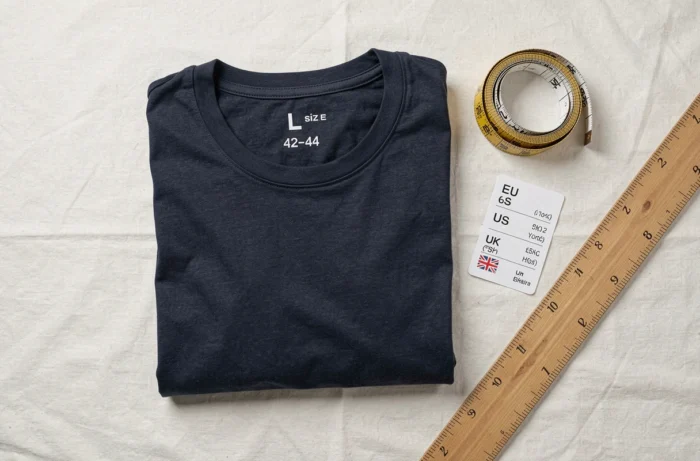
What changes between a fitted L and an oversized L
The letter L says nothing about the ease intended by the manufacturer. Two pieces labeled L, intended for the same chest measurement, can offer very different comfort depending on the cut.
A fitted t-shirt (“slim fit”) in L follows the body’s lines with little margin. An oversized sweatshirt or jacket in L adds several centimeters of ease at the shoulders and bust. The material also plays a role: a stretchy fabric compensates for a tight pattern, while a rigid fabric (denim, gabardine) requires more margin to remain comfortable.
A slim cut L and an oversized L can differ by more than 10 cm when laid flat. When a product sheet does not specify the cut, look at the worn photo and the material description. These two clues often provide more information than the letter alone.
Choosing a size in clothing relies less on the letter printed on the label than on three reflexes: checking whether the guide measures your body or the garment, taking your own measurements with a measuring tape, and reading the type of cut before finalizing the cart. These habits, once adopted, become automatic, and returns due to incorrect size almost entirely disappear.