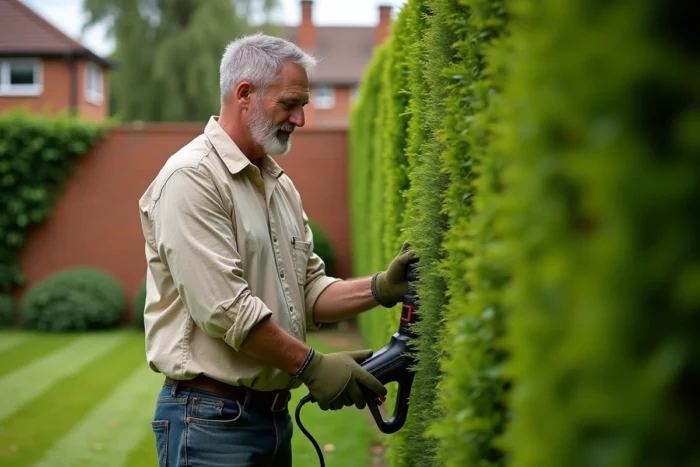
A powerful electric hedge trimmer that works well for one person may be unsuitable for another. Power and price often dominate comparisons, but the determining factor remains the nature of the hedge itself: its thickness, age, height, and distance from a power outlet. This parameter truly guides the choice of the best electric hedge trimmer.
Which electric hedge trimmer according to your hedge profile
Buying guides categorize models by type of power supply or price range. This approach overlooks a central point: two gardens with different hedges do not have the same technical requirements at all.
A homeowner maintaining a young photinia hedge has no comparable needs to someone who must tame an old, woody privet. The table below summarizes the technical criteria to prioritize according to four common situations.
| Hedge Profile | Recommended Tooth Spacing | Suitable Power Supply | Blade Length |
|---|---|---|---|
| Young soft shoots (photinia, recent laurel) | Narrow | Wired or lightweight battery | Short to medium |
| Thick and old hedge (privet, mature hornbeam) | Wide | Powerful wired or gas | Long |
| Precision finishes (boxwood, topiary) | Very narrow | Compact battery | Short |
| Tall hedge or far from an outlet | Variable depending on species | Battery with good autonomy | Medium to long, or on a pole |
The spacing of the teeth determines the maximum diameter of branches that the device can cut cleanly. Too narrow a spacing against woody branches causes jams and damages the blade. Conversely, wide spacing on young shoots results in an uneven cut. The tooth spacing must correspond to the actual diameter of the branches, not to the power indicated on the packaging.
To delve deeper into the technical characteristics and compare specific models, the detailed sheets available on taille-haie-electrique.com allow for cross-referencing these criteria with precise references.
Wired or battery hedge trimmer: what autonomy really changes
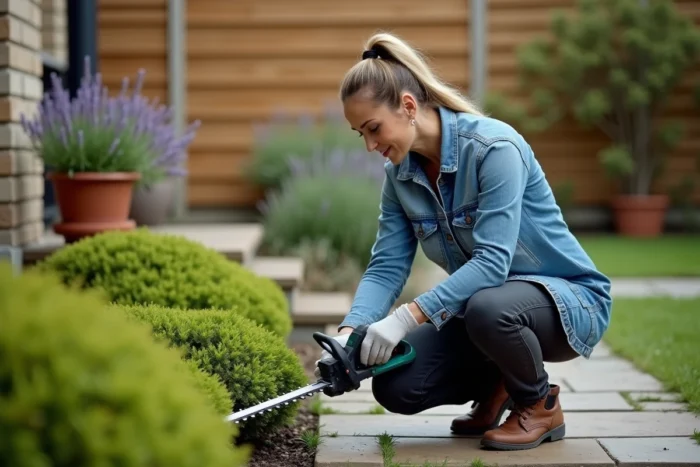
The debate between wired and battery often boils down to a question of mobility. In practice, the choice involves less obvious compromises.
A wired model offers constant power from start to finish of the session. It does not lose power over time. In contrast, the extension cord limits the range of action and presents a real risk of accidental cable cuts, especially on long hedges with many passages.
A battery model gradually loses cutting power as the charge decreases. On a dense hedge, this drop is felt even before the battery dies: the last minutes of work produce a less clean cut. For a hedge a few meters long, this phenomenon remains marginal. On a garden perimeter hedge, it may require a battery change during trimming.
Weight as a factor of cumulative fatigue
The rise in power of battery models comes with extra weight due to the power pack. This additional weight, distributed differently depending on the brands, alters the balance of the device.
During a short trimming session, the difference is negligible. During two or three trims per season of tall hedges, with arms raised above shoulder level, the comfort of use depends more on balance than on raw weight. A slightly heavier but well-balanced device tires less than a lightweight model with a poorly placed center of gravity.
Blade length of the hedge trimmer: the trap of “longer is more effective”
A long blade allows for covering more surface area with each pass. This reasoning is correct on a straight, flat, and clear hedge. It becomes counterproductive in other configurations.
- On a narrow or rounded hedge, a long blade complicates curved passages and makes finishes approximate. A short blade offers more precision and maneuverability.
- For tall hedges requiring vertical cuts, the blade length must be consistent with the user’s arm span. Beyond a certain threshold, control decreases and the cut becomes uneven.
- On thick hedges, a double-action blade reduces vibrations compared to a single-action blade, regardless of its length. This criterion directly affects the fatigue felt after an hour of work.
The choice of blade length should therefore start from the shape and accessibility of the hedge, not from a pure efficiency logic.
Telescopic pole hedge trimmer: for which gardens
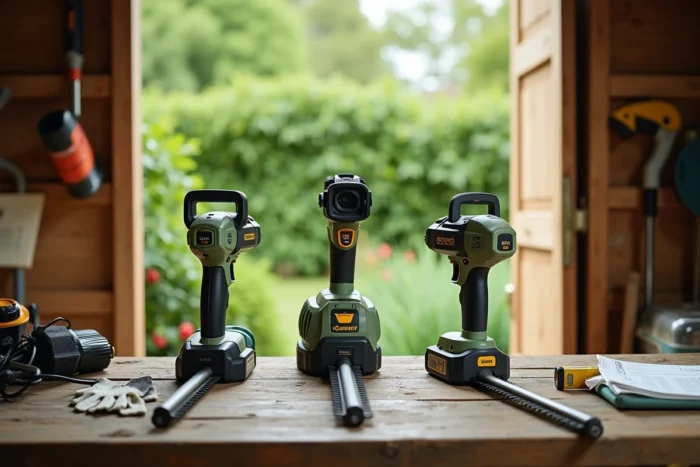
Models on poles meet a specific need: to reach the top of tall hedges without a ladder. They do not replace a traditional hedge trimmer for side faces or low finishes.
The telescopic pole adds weight and reduces cutting precision. The working angle, often adjustable in increments, does not always suit the exact geometry of the hedge. The result is acceptable for regular maintenance but insufficient for a clean finish on species with fine foliage like boxwood.
A garden with a mixed hedge (accessible lower part, upper part over two meters) may justify two distinct tools rather than a single compromise. A compact model for the sides and a pole hedge trimmer for the top provide a cleaner overall result than a single versatile device used in uncomfortable positions.
Trimming period and regulations
The French Office for Biodiversity recommends avoiding trimming hedges from March 15 to July 31, during the nesting period for birds. This recommendation applies to all types of hedges and all tools, including electric hedge trimmers. Planning trims in late summer and autumn allows for respecting this window while intervening when growth slows down.
The best electric hedge trimmer is not the one with the most impressive technical sheet. It is the one whose tooth spacing, blade length, power supply type, and balance correspond to the actual hedge in the garden. Starting from the hedge rather than the catalog remains the most reliable method to avoid a disappointing purchase.