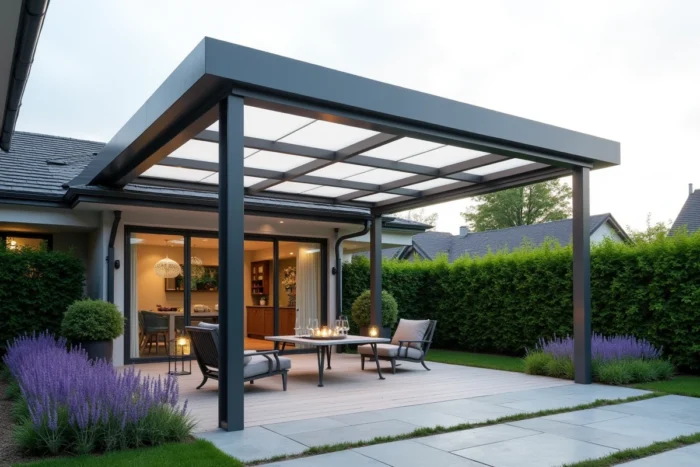
When you have a 12 m² terrace facing south and the awning starts to wear out, a kit pergola becomes a serious option. At Brico Dépôt, the catalog covers several configurations, from aluminum wall-mounted models to free-standing wooden pergolas. The choice is not limited to material or price: resistance to climatic loads, the type of roofing, and compatibility with the facade determine the durability of the installation.
Snow loads and wind resistance: the criteria revealed by the manuals
People often look at dimensions and color, but rarely read the technical sheet thoroughly. Some recent aluminum pergolas from Brico Dépôt have a snow load capacity of up to 120 kg/m². This level of resistance corresponds to mountainous areas or harsh climates.
This information changes the game if you live in the east or at altitude. An entry-level pergola not rated for snow may deform during the first winter with significant snow. Checking the permissible load before purchase avoids structural disappointment.
For wind, feedback varies depending on the models and fixing conditions. Anchoring on a concrete slab with bolted plates does not provide the same stability as simple weighting. The manual provided with the kit generally specifies the maximum tolerated wind speed, but this information is rarely found online before purchasing in-store.
By browsing the Brico Dépôt pergola models, you can quickly identify which aluminum models are designed for these constraints and which remain lightweight structures intended for summer use.
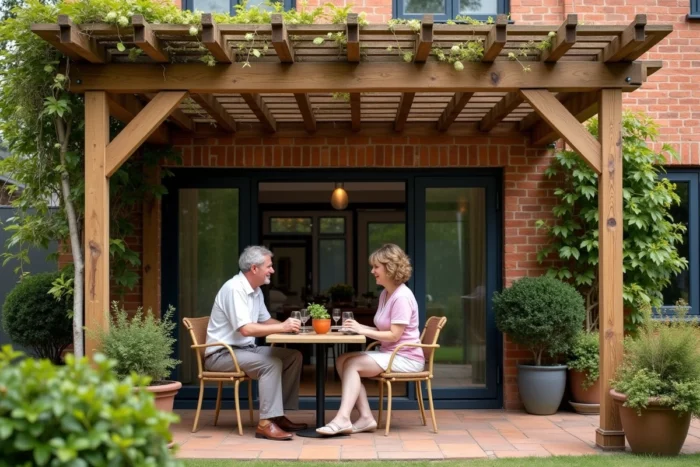
Aluminum pergola with adjustable slats: operation and concrete limits
The Brico Dépôt catalog now includes bioclimatic pergolas with adjustable slats. The principle is simple: aluminum slats pivot to modulate sunlight and ventilation. Closed, they protect from rain. Opened at 90°, they allow air and light to pass through.
The orientation of the slats can be adjusted manually or with a crank on most Brico Dépôt models. Motorized versions exist but at a significantly higher price.
In practice, assembling a pergola with adjustable slats requires more precision than a classic polycarbonate roof. The alignment of the slats must be perfect to ensure watertightness when closed. It is recommended to have at least two people, with a laser level and plenty of time.
Points to check before assembling a bioclimatic kit pergola
- The plumb of the posts: a gap of a few millimeters is enough to jam the slat rotation mechanism over the months
- The integrated gutter: some Brico Dépôt models include a rainwater drainage system in the posts, preventing streaks on the terrace
- The gap between the slats: too tight, it blocks due to thermal expansion in summer; too loose, it lets water through when closed
Mixed wood and aluminum models: a recent alternative at Brico Dépôt
Since the spring-summer 2025 catalog, Brico Dépôt has offered pergolas combining an aluminum structure with wooden cladding. Specifically, the posts and frame remain aluminum for rigidity, while decorative wooden slats dress some sides.
The result is a compromise between the durability of aluminum and the warm appearance of wood. You retain the structural lightness of aluminum without the cold aspect that some criticize.
Maintenance remains a point to anticipate. The aluminum part requires only water cleaning. The wooden elements, on the other hand, need a stain or saturator every two to three years to prevent graying. If you want zero maintenance, it’s better to stick with a 100% aluminum model.
Wall-mounted or free-standing pergola: choose according to the terrace configuration
The wall-mounted pergola attaches directly to the facade of the house. It extends the indoor space to the outdoors and benefits from solid structural support. In return, the wall fixing requires drilling into the load-bearing wall or lintel, which can be problematic on certain facades (ITE, cladding, recent plaster).
The free-standing pergola, on the other hand, stands on its four legs. It can be positioned anywhere in the garden, away from the house. It offers more freedom of placement but requires a more robust ground anchoring to compensate for the lack of wall support.
Which type for which use
- Terrace adjacent to the house, daily use (meals, outdoor lounge): the wall-mounted aluminum pergola remains the most functional choice, with direct access from the bay window
- Relaxation area at the back of the garden, pool or spa space: the free-standing option is essential, as it does not depend on any existing structure
- Sloped terrain or loose soil: plan for concrete blocks under each post, regardless of the chosen configuration
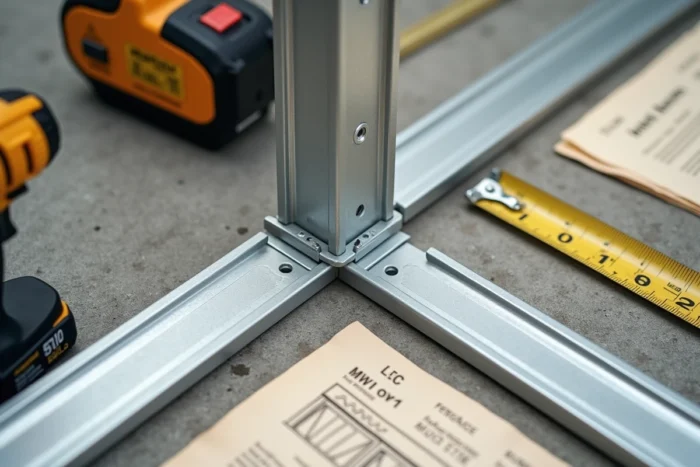
The Brico Dépôt kit generally includes fixing plates and screws. The assembly instructions detail the steps, but the quality of the instructions varies from model to model. For standard-sized aluminum pergolas (3 x 3 m or 3 x 4 m), assembly generally takes half a day with two equipped people.
The choice between wood, aluminum, or mixed depends as much on the budget as on the tolerance for maintenance. A well-anchored aluminum pergola adapted to local climatic loads will last for years without intervention. Wood adds a different charm but requires regular upkeep. In any case, reading the complete technical sheet in-store, especially the wind and snow resistance data, remains the best way to avoid a poorly calibrated purchase.