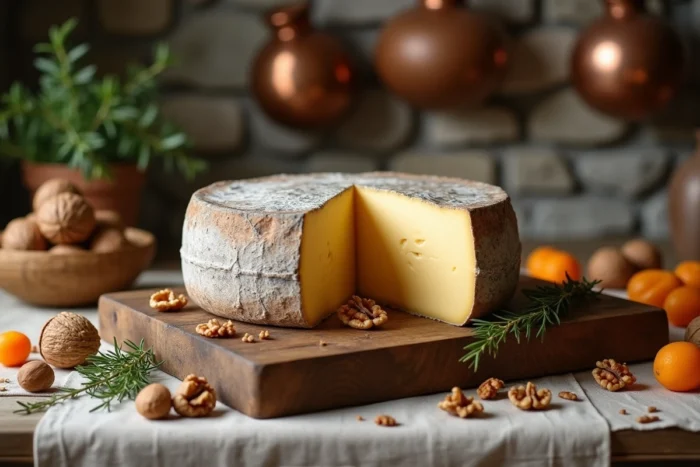
Both Comté and Cantal hold the AOP designation, are made from cow’s milk, and belong to the large family of pressed cheeses. Their resemblance stops there. Everything separates them: the mountainous region of origin, the manufacturing process, the aging duration, and the aromatic profile. This article measures point by point what distinguishes these two pillars of French cheese heritage.
Comparison Table: Comté AOP vs Cantal AOP
| Criterion | Comté AOP | Cantal AOP |
|---|---|---|
| Region of origin | Jura Mountains (Franche-Comté) | Massif Central (Auvergne) |
| Type of paste | Cooked pressed paste | Uncooked pressed paste |
| Milk | Raw cow’s milk (Montbéliarde, Simmental) | Raw cow’s milk (notably Salers) |
| Minimum aging | 4 months minimum | 1 month (young Cantal) |
| Aging stages | Evolving profile based on duration (young, semi-aged, aged) | Three codified stages: young, semi-aged, aged |
| Production structure | Cooperative dairies | Large wheel production, farms, and dairies |
| Rind | Washed rind, brown to golden | Dry rind, grayish to brownish |
| Texture | Soft to firm, melting | From crumbly (young) to brittle (aged) |
This table highlights a fundamental difference: Comté is a cooked pressed cheese, while Cantal is an uncooked pressed cheese. This technical distinction conditions everything else, from texture to the aromatic palette. To understand the difference between Comté and Cantal, this is the first point to remember.
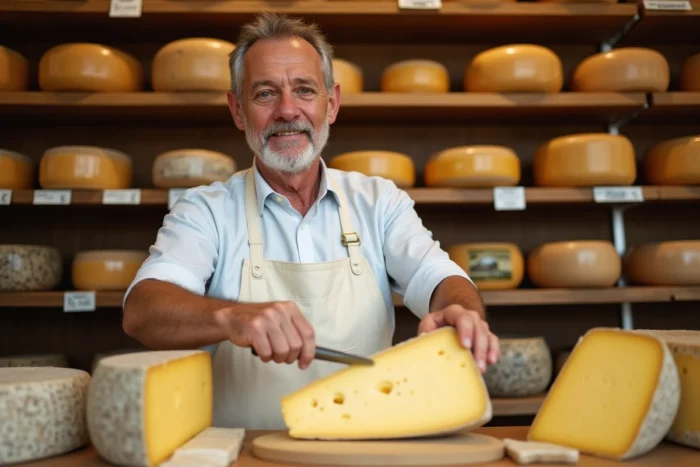
Cooked or uncooked pressed paste: how the process changes the taste
The cooking of the curd is the step that separates the two families. For Comté, the curd is heated to a high temperature before pressing, which expels more whey and produces a dense, soft paste capable of withstanding long aging. Cantal, on the other hand, undergoes pressing without prior cooking: the paste retains more moisture, making it crumblier and directing the work of the cultures differently.
In the mouth, the consequences are clear. Comté develops aromas of dried fruits, roasted hazelnuts, and sometimes caramel when aged longer. Young Cantal leans towards fresh butter and lactic acidity, while aged Cantal takes on earthy, tangy notes, sometimes reminiscent of British farmhouse cheddar.
The cooking process also explains why Comté is better suited for very long aging. Its dense paste evolves slowly, gaining complexity without degrading. Cantal reaches its optimal maturity more quickly and loses its structure beyond a certain threshold.
Aging of Comté and Cantal: three stages, two logics
Cantal is available in three official aging stages: young (one to two months), semi-aged (about two to six months), and aged (beyond six months). These categories appear on the label and directly guide the consumer towards a specific use.
- Young Cantal melts easily and is suitable for gratins, croque-monsieur, or sauces. Its lactic sweetness does not overpower other ingredients.
- Semi-aged Cantal offers a balance between melting and character. It works well both on a cheese platter and in cooking.
- Aged Cantal, dry and powerful, is enjoyed in thin slices or shavings. Its intensity calls for simple accompaniments (country bread, full-bodied red wine).
Comté does not use exactly the same official nomenclature, but the minimum aging of four months imposed by the AOP sets a higher baseline than for Cantal. In practice, cheesemongers distinguish Comtés of a few months (fruity, soft) and Comtés aged well beyond (complex, crystallized). The aromas of Comté evolve significantly with aging duration, shifting from milky to roasted depending on the cellars and production seasons.
Impact of the production season on Comté
Summer milk, from cows fed on mountain grass, yields a cheese that is yellower and more aromatic than winter milk. This parameter, linked to the system of Jura dairies, has no equivalent as pronounced in the Cantal sector, where variability is more related to the expertise of the affineur than to the seasonality of grazing.

Dairy cooperatives vs Auvergne production: two production models
Comté is historically produced in dairies, village cooperatives where farmers pool their milk. This collective model structures the entire Jura sector and explains the consistency of the finished product. Each dairy processes the milk of the day, then entrusts the wheels to specialized aging houses.
Cantal follows a different pattern. Production can be farm-based (one producer, from milk to wheel) or dairy-based (broader collection). The Salers breed, emblematic of Auvergne, produces milk rich in fat that leaves a specific mark on the cheese. The Salers AOP, a cousin of Cantal made exclusively with milk from Salers cows during the grazing period, takes this terroir logic even further.
In terms of volume, the Comté sector represents a significantly higher production than that of Cantal, which translates into a broader presence in large distribution. Cantal remains proportionally more artisanal, with a significant share of farm production.
Pairings and uses in cooking: choosing according to the dish
The question of choosing between Comté and Cantal depends less on a hierarchy of quality than on the culinary context.
- For a fondue or gratin, young Cantal provides melting without dominating. Aged Comté will add depth but may risk masking delicate flavors.
- On a cheese platter, a long-aged Comté serves as the centerpiece. An aged Cantal complements it with more rustic notes.
- When paired with wine, Comté goes well with a Jura yellow wine or a chardonnay. Aged Cantal calls for a red from Auvergne or a Saint-Pourçain.
Young Cantal excels in everyday cooking, while aged Comté shines in tasting. This practical distribution reflects the very structure of each cheese: the former melts, the latter is savored.
Two AOPs, two mountain ranges, two manufacturing techniques, and ultimately, two distinct tasting experiences. The choice between Comté and Cantal is not made on a single criterion but on the combination of the dish, the season, and the desired aging stage. Tasting both side by side, in their young and aged versions, remains the most reliable way to identify which corresponds to each use.